
Some years ago, a young (mid-20s) woman I know had treatment for clinical depression. This surprised me because she was well-adjusted and had a job she enjoyed. She was also a strong Christian, not simply a churchgoer.
A while after that, my wife told me about a conversation she had with a good friend (mid-50s). This friend reported that she was unhappy about the fact that another friend usually got more “likes” on her Facebook posts than she did. My wife encouraged her not to focus on the number of likes and instead on the content of the posts, but it didn’t seem to have much effect.
Over the last few years, I’ve seen more and more headlines about the rise in depression in the U.S., particularly among millennials and Zoomers (Gen Z). For a while, there were a lot of references to the COVID lockdowns as a culprit, and I have no doubt that they contributed a great deal. However, broadly speaking, the lockdowns had ended by the summer of 2021, and here we are five years later. I decided to do some digging to see what I could find.
Regarding demographics, I was primarily interested in age, and secondarily with gender. Even though the most recent CDC stats are from August 2021-August 2023, I think they provide a good picture. You can take a look at a rather illuminating graph here, if you’re interested: https://www.cdc.gov/nchs/images/databriefs/501-550/db527-fig1.png One thing immediately obvious is that overall, depression was highest for the 12-19 age group (19.2%) and lowest for 60 and older (8.7%); furthermore, there was a very steady decline in depression with age, overall. One interesting difference in this trend was that for males, there was an uptick from 12.2% in the 12-19 age group to 14.3% in the 20-39 age group. However, in every age group, the percentage of females with depression was much higher than that of males.
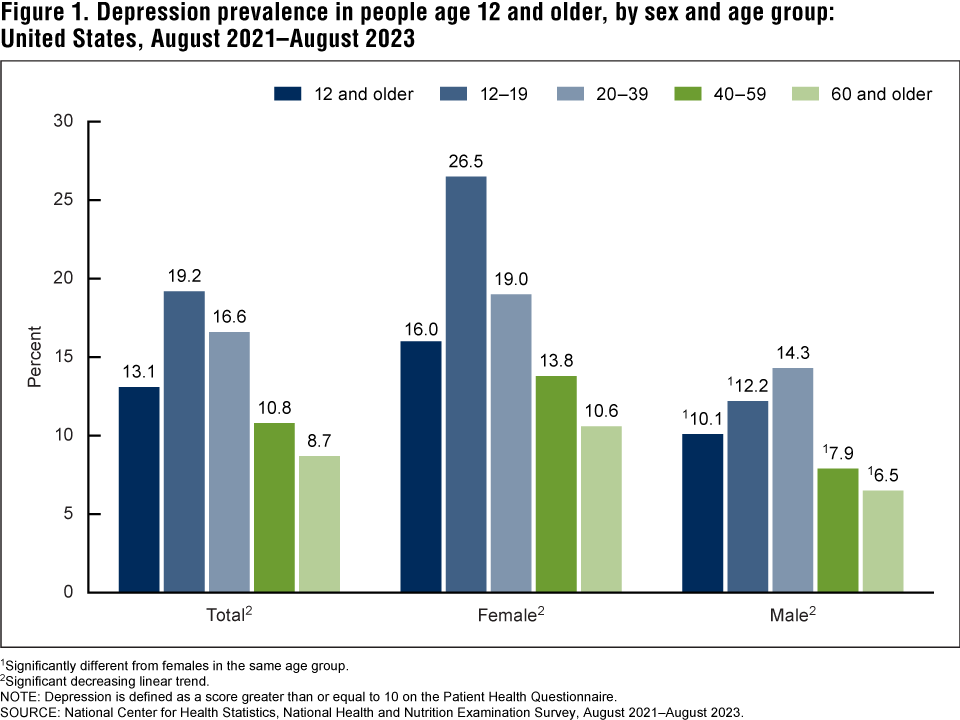
It is well-known that girls and women are more likely to report depression than boys and men. However, I suspect that even if males reported it more, we would still find that females experience depression more than males do. Regarding age: I think there is definitely a reporting bias since people in the 60 and older age bracket were–and probably still are–significantly less likely to report depression than people who are younger. Nevertheless, I find this age difference interesting given that older people generally have significantly fewer years left to live than younger people. Regardless, since depression has become destigmatized in American society over the last 40 years or so, we shouldn’t be surprised that people are reporting it more than they used to, especially among younger generations.
In addition to the CDC report, I noticed a Gallup poll from 2023 that reported depression rates were at an all-time high. For adults (18 and older), the percentage of those with depression skyrocketed from 10.5% to 17.8% in a mere eight years, since 2015.
While I find these stats very interesting, the question I posed in the title of this post is why depression keeps increasing. First of all, there is the already-mentioned reporting bias. Second, I’ve noticed an increasing tendency among parents to say, “I just want my kids to be happy.” When parents communicate this to their kids, whether directly or indirectly, they are setting them up for disappointment because happiness becomes what their kids are likely to expect. When it doesn’t happen, we shouldn’t be surprised that eventually, depression is going to be a likely outcome. Third, as I thought about the two women I mentioned at the outset, one thing they have in common is that they both spend time on social media; this was especially noticeable with my wife’s friend, who complained about the comparative number of likes she received on her FB posts. Thus, I was not surprised, when I did some further digging into reasons for depression, that social media and comparison were frequently mentioned. Along with this, young adults, especially, reported being lonely. I suppose some might think that with the constancy of social media in the lives of so many, one might feel “connected.” However, it should be obvious that just because someone has hundreds of FB friends, for example, it says nothing about the depth of relationship. When a person doesn’t have truly close friends, some degree of loneliness is almost inevitable. And it’s impossible to overestimate the importance of even one or two close friends who live nearby.
I should mention that there are other causes of depression, including economic pressure and the pressure to achieve, whether it be in school or at work: no surprise there. The unrelenting negative 24/7 news cycle certainly doesn’t help, either. However, the large amount of time that the average person (certainly including kids) spends on social media is a relatively recent development. Facebook, for example, has been around for only 20 years. Reddit’s huge surge in popularity began in 2010, the same year that Instagram launched.
I’m not saying that social media is bad, only that its influence has very significantly changed the ways that people tend to interact. My primary social media account is right here, with WordPress, although I also have a Nextdoor account that I use a bit; that’s enough for me. I have very much enjoyed getting to know some of you online over the past six years; however, you are a very welcome addition to the people I know in person, not a replacement for them.
Jesus called us to love our neighbors. May all of us bless one another in good friendships, both in person and online–and in some cases, both!
I appreciate you approaching this subject, Keith. Stats are probably hard to track because of past ages when this was a subject that few discussed. I like that you did some research here. I know that everyone gets depressed at some time in their lives but the severity of the depression differs from person to person. I don’t understand how some unbelievers in God never seem to be depressed. Without the hope that only God can give us by His grace alone, through His faith alone, and through Christ alone, I don’t know hope anyone has true hope. I suppose people can have hope in things that don’t hold real hope.
Anyway, I do believe that the earth is wearing out like a garment and that no matter how strong a person’s faith is they can still have inherited depression. I think that those pastors who say that we have depression because we are not faithful enough are wrong. I think of the Christians of the past who struggled with strong depression at times and somehow still had great ministries. Some believers are greatly benefitted by modern medications. Most spells of depression probably don’t need medication but there are people who are diagnosed with depression that can be debilitating. People like this can be helped through prescribed certain prescribed medications.
Again, I appreciate this post. Thank you, Keith.
Thanks, Chris. I agree that probably everyone experiences depression at some point(s) in their life; I remember experiencing some at two different times when I was looking for work (after I became a Christian) as well as during my late teens one summer (before I became a Christian). Pastors who say that we experience it because our faith isn’t strong enough are wrong; Elijah in 1 Kings 19 comes to mind. For people who don’t know the Lord, it must be incredibly hard to endure depression.
Regarding medication: I don’t know very much about medicating depression, but I know that some people have been helped by it.
Thanks again, Chris, for your thoughtful comment.
You’re welcome, Keith, and thank you for your comment.
Keith, I think there are two reasons for the depression among younger Americans: one is lower church attendance; individuals who do not attend church generally have less faith in God and also lack the support network of the local church. Another reason is that it is harder to get ahead economically due to the outsourcing of jobs to lower-wage nations and also to automation. AI is only going to make this problem worse. These are also important reasons for the social and political polarization in our nation. May the Lord bless your work for His kingdom.
Thanks, Tony. I think the reasons you mentioned are valid ones; in fact, I referred to the second one in a more general way in my post. Regarding your first reason: I made mention of the loneliness that young people are experiencing, which is part of what you mentioned. On a deeper, spiritual level, not having true, saving faith in God is also definitely a factor, even though it was not reported in the research that I did.
As always, I appreciate your comment!